Sunday, June 4, 2023

Russo's Straight Man

 Since that fight with Galigar at the book club about Empire Falls I have not wanted to read Russo.  

He was obnoxious merely because I said that I thought there was too much foreshadowing and that spoiled the ecperience for me and that the last chapter seemed tacked on to a novel that had finished.

This book was very different.

No foreshadowing.  It was a mystery up until the end what would actually happen.  And the last chapter just tied things up and gave closure.

It was very funny and delightful.

One of my inner wishes has always been that I would work on a college campus and be part of the academic scene, more interested in literature than in discipline.  I never did it.  

I like reading about it.

I read another novel set on a campus recently.  The name escapes me.  It was written by a fellow i associate with criticism of a major author.  It will come to me.  Or not. 

I liked that one as well.

But the other was a bit dark and this one was just hilarious. All the twists and turns and the narator's inner thoughts and feelings kept me enjoying.

There was one scene where he imagines confronting black men on his porch that was a pit politcally incorrect.  It would bother me to suggest the book to Black readers.  Today, that would have been edited out.

All the rest worked well.  Great characters.


STRAIGHT MAN | Kirkus Reviews


[ˌäkəmz ˈrāzər]
NOUN
  1. the principle (attributed to William of Occam) that in explaining a thing no more assumptions should be made than are necessary. The principle is often invoked to defend reductionism or nominalism. Compare with principle of parsimony at parsimony

Thursday, June 25, 2015

Colson Whitehead's book The Noble Hustle

Tuesday, June 23, 2015

Colson Whitehead's book The Noble Hustle

I just finished this book.  I liked it.  Not everyone would, but perhaps more than liked other poker books.  It is nonfiction.


The Noble Hustle:  Poker, beef jerky, and Death


The tone of the book is set by the country the author imagines he comes from

Anhedonia   -  The inability to experience pleasure

This gives him one advantage.  He has a perfectly natural dead expression, a true poker face.

"We anhedonians have adapted to long periods between good news.  Out national animal is the hope camel.  We have no national bird.  All the birds are dead."p.47

"For the citizens of the Republic of Anhedonia, luck is merely the temporary state of outrunning your impending disasters."p.96

Here is background information
http://www.colsonwhitehead.com/Home/Home.html

Colson is not writing a novel this time, although it reads like one.
Instead he is telling the story of being in the 2011 WSOP, not because he was a polished poker player, but because he was offered a free buy-in if he would write an article about his experiences.

This is not your typical poker book.  It is linquistically wild and fast moving with bizarre metaphor, allusion, and commentary.  He laughs at all of it, including himself.
At the same time, it is easy to identify with the poker stories. 
I don't much like the WSOP, where I experience  the game as a cross between a ProBass fishing tournament blended into a rather bad Hollywood flick, so for this book to keep my attention until the end is saying a lot.
But then I'm a frugal guy.
So is Colson in real life.
So I get him.

Ironically, I get him in spite of the fact that his style is one of a modern generation and not what usually appeals to me at all.   I don't ready too many book that flow......or should I say spurt like this one. 
I suppose partly I liked it because my son Frank liked it, read it, sent it for a Father's day gift. 

I also liked it because it was not an egomaniac book of directive instruction.  Here was a fellow like me, although much younger, caught in an adventure of poker playing.

It got a great kick out of his naming of stereotypical players:

Big Mitch is a potbellied endomorph in fabric-softened Khaki sorts and polo shirt, a middle aged white guy here with his wife, who was off dropping chips on the roulette felt according to her patented system."p.10

Methy Mike is a harrowed man who  had been tested in untold skirmishes....  If Methy Mike had been hitched, the lady had packed her bags long ago and if they had spawned, their parenting goals probably ended with making sure their kid didn't get a tattoo on her face, and they did not always succeed....Methy Mikes are on a first name basis with the bosses and dealers and cocktail waitresses, and you can count on a bit of catching up.....They are weathered by the sun, by their lifestyles, which you can only guess at, the underlying narrative of their decay, and resemble unfortunates who have been dragged on chains from the back of a beat-up van and left to desiccate in the desert....

And then there was Robotron, lean and wiry and hunkered down, a young man with sunlasses and earbuds, his hoodie cinched tight around his face like a school shooter or a bathroom loiterer...  Robotron is only here tonight because the Feds shut down all the US online poker sites.

He did not name old guys like me, but here is one he encounters:

"an elderly white man who bent over his chips, squinting through a magnifying attachment that barnacled on his thick specs like a jeweler's loupe.  Her pondered before acting, as if reviewing a lifetime of hands and confrontations, or fighting off a nap."

This fellow is really not much like me, but I've met him at the tables.

Here are some other bits I found worth noting:

"Gamblers and the lovesick want to bend reality.  But it's never going to happen.  If you woke the hell up, you'd understand that and stop chasing."

Like all poker books, some of the places he writes about have closed.  Showboat at Atlantic City, for example.  There is never much history in casinos.  They just don't last.

There is quite a bit about his reading to prepare for the game.  I have never found strategy books of much value.  I can't seem to absorb, remember and apply anything.  He seems to respect the Dan Harrington writings of which I'm not familiar.

Of course, I rarely play tournaments and not for big bucks but just for amusement or as freerolls earned by accumulated hours. 
So, his term for the blinds, Wave of Mutilation, does not affect my games.  In NL I like 1-1 games because the blinds really don't matter very much.  Often 1-1 is a post flop game.  I like that.  It is very different from the higher stakes games and from tournaments.

"I pity people who've never been to Vegas.  Who dismissthe city without setting foot on its carpeted sidewalks,  I'll forgive the sanctimony in the question, "But what do you do there?  The obnoxious self-regard are as American as smallpox blankets and supersize meals. "p.101

Since this is nonfiction, the people mentioned are not characters, but real folks.  Matt Matros plays a role in his adventure.
https://en.wikipedia.org/wiki/Matt_Matros

as do other unnamed players, like the woman who becomes his coach.

Here is a bit for the weekly poker game
"Everyone tilts, but he who tilts less, tilts best."

"SitnGoes were not, as I mistakenly thought, adult diapers for poker players, so they don't have to leave the table."  p.149

I enjoyed the reference to the Butterfly Affect which I think I first experienced with a Ray Bradbury story, but which does permeate the culture and certainly apply to our experience of poker.
https://en.wikipedia.org/wiki/Butterfly_effect_in_popular_culture

Wild Bill once gave a seat up in the Flamingo to a pretty young girl who was just behind him on the list.  Within a few hands, she hit a royal flush for a Bonus payout of $1400.  It could have been Bill.

Or not, since randomness is more like a RNG than destiny.

I also like the idea that Colson knows his limitation.

"I would never understand the game the way they did, no matter how much I studied or hit the tables.  The part of the brain these guys used for cards, I used to keep meticulous account of my regrets."

This is exactly why I stay away from high priced tournaments and use table selection as my major source of advantage at the lower stakes and limit games.

"Our country disdains a risk reward game that millions of Americans play, then bails out Wall Street sharks who bet unfathomable sums.  I can only conclude that this contradictory status has little to do with the skills required for each pursuit.  No, for some reason, lawmakers just don't like poker." p.  163


 I suggest that the reason poker takes a back seat is the same reason it takes a back seat in casinos.  It is a lost leader.  Government now is like the mob.  They get their 'taste' by setting up negative expectation games and luring in folks to fleece.  It is the same reason that any video poker that pays over 100% is illegal in NY State.  It is not about disliking poker;  it is about liking taxation more than providing services.

One new concept for me was the concept of M and I thought it would help my tournament play, but I doubt I'll remember it.  I barely remember how to figure outs and I only do the math for chasing flushes and straights in a general way.

" To calculate M, you add the Big Blind, the Small Blind, and all the antes you have to pay into the pot each round, and the sum is how much it costs to play one orbit"

"Establishing table image is like when you stab the leader of the Aryan Assholes in the neck with a fork after your first day in prison: tellin' em how you do it back home." p.186

on the Fremont Experience:

"Tourists foolish enough to be ensnared by the promos for this crummy light show look up for a few minutes, and then it's over.  They drift away.  The night is young, the city endless, and there are so many more disappointments to savor before dawn."  p.  206

Talks about his poker knowledge slipping away Flowers for Algernon style.

Well, I don't know if I ever knew anything that matched the top of that curve, but I sure do feel the slipping of knowledge in every category. 
In two years I will have forgotten reading this book.  So, I'm happy to have these notes.

Thursday, August 14, 2014

Rabbit Run Updike and the sequels

I've tried this before.  I've always thought I ought to read this famous series.  Frank is reading the first one now and so I thought I'd read with him.

I understand what makes the novel off putting for me.  The character is very self focused and yet I feel like Updike wants us to identify.
For me he was the classic spoiled suburban guy with plenty of good things to enjoy but feeling sorry for himself.  So he runs from his marriage and family.
He has a small boy and another child on the way, and he seeming lack of any concern about them just seemed cold.  He does not seem to miss them or appreciate the pleasure of having children.  In fact, he is one of those fellows who is so much a child himself that he has no real parenting energy.
So impulsively he makes a run.
That seems stupid too.  I left a marriage and it took a long, long time to think it through and plan the departure.  He just goes with a few dollars in his pocket and then hooks up with whomever.
He finds a prostitute who is in my feeling one of the least desirable women in literature.  Somehow he charms her.  The classic feeling that the right kind of lover can reach the cold sexual place of the prostitute and be proud of that is just too much macho crap for me.
Currently, he is forming a rather strange relationship with an Episcopal priest who thinks that playing gold with Rabbit is the way to win him back.
It would all be pretty funny were it not so sad.

Characters include an old coach who is degenerate and weak in memory and any sensitivity although he helps Rabbit a bit, giving him a place to rest and introducing him to the prostitute Ruth.

The sexual scenes were certainly a bit different for the age of the novel, but they really turn me off.  It is the opposite of erotic.  I can see why as a college kid in the age where sex was fun and included relationship would be turned off by this sexual relationship.  And I'm getting that she is now pregnant because neither of them acted to preclude that.  I never quite got the idea of how men and women who were screwing daily could be so unconcerned about possible children.

I got the novel on disc and I like the reader.  Then I have a paperback for when I am home, so the novel goes along well enough.

Perhaps I am just too old.  Perhaps I want everything to be like funny 30's movie where the romance happens between people I like and in the end things work out somehow.  Not a very educated way to filter fictional experience, I guess.
*****************
In the end I finished all the Rabbit books and felt much more attached to Rabbit and his issues.  I feel I accomplished a like long goal of reading in doing this even if I have no one to discuss the novels with.

The Goldfinch


This book is going through my personal community like a wildfire.  It was in Elizabeth's book club, will be in the men's book club I never visit, and Abigail stayed up late to finish the long work she got so engaged.
I am reading it on Kindle and liking that.  I zip right along.  I miss taking notes and I'll miss recording some of the wonderful language in this book.  It is amazing.  It is rare in this age of sound bites to find an author who takes time for all the details possible.  At times I want it move faster, want it edited down.  At other times it is a fine indulgence.
Plot moves too slowly.  That could be shortened without loss. 
Just now the author skipped ahead 8 years.  Odd for an author who does not seem to be able skip ahead 8 minutes.  I can't figure out why.

I always liked coming of age fiction, even before I taught school.  So it is the right kind of story and character.  I can identify with this character, unlike the spoiled Rabbit in the Updike book.  

Vegas was strangely presented.  It was seen from its worst perspective.  There is some truth to it, but it was not balanced.  Even the poor RTC took a hit from this author.
New York on the other hand is a dreamy place, full of interesting characters like Hobie, a fine furniture repair guy who we admire and who has the most influence on the main character.

His one love relationship is very romantic and classically so because conditions cause him to be unable to pursue her, at least as far as I've gotten.

The subplot of the "stolen" art and what to do about it seems very unrealistic.  It would seem that it would be very easy to get this returned with no questions asked and no criminal repercussions.  It could be returned to an anonymous art lover or to the FBI.  It could be left in a locker and the key sent to the police.  Instead the main character seems stuck with it and afraid of what might happen were he discovered to have it.

I'm also a bit put off that there is so much tragedy.  Everyone seems to die a violent and early death.  This moves toward less than the believable.

E's bookclub split on the book.  Some loved it and some hated it.  Some agreed it should have won the Pulizer and others thought it did not count as literature.  Francine Proze was very critical of the work which in some ways is the sort of story she writes, with adolescents as main characters.  However, I think Proze has an inflated idea of her own expertise.  This is as good a novel as the two I've read by her.  As to what is great literature, that seems a rather pointless  kind of decision.  Great literature is partly determined by its own merit, by how many books are in an author, by the politics of the selling of the book, and by the way the book grabs the audience in mass.  On one level the question of what is great literature cannot be answered unless we wait until the author is as old as Shakespeare is now or at least as old as Twain.

Anyway, it is fine to be reading again on a regular basis.  It does take me out of all the Peter worries and put me in a different place for a while.  That is great.


Wednesday, May 7, 2014

Portugal Fishing book

Finally located this book I read a few years ago.
http://www.goodreads.com/book/show/2155196.Last_Old_Place
And a few notes on another book by the same author.

BELGRADE - Anna Proper stood out her back door overlooking a sprawl of 60 acres south of Belgrade, which she and her late husband bought in 1987.


"Sometimes he grabbed me and gave me a big hug," Proper said. "He then pointed and said, 'Do you see that?'"
 

Subscription Required

An online service is needed to view this article in its entirety.
Have an online subscription?
Login Now
Need an online subscription?
Subscribe

You must login to view the full content on this page.


He showed her wildlife, trees and plants, which blanket the couple's property.
That was Datus Proper's way: to pay attention to detail. And, with wit and charm, he shared nature's details with his family, friends and readers.
Datus drowned Sunday evening while fishing Hyalite Creek. An author of four books, Datus also was a regular contributor to Field& Stream magazine and a former U.S. diplomat. He was 69.
He grew up in Yellowstone National Park, before driving his Indian motorcycle to Cornell University in New York to get a degree in English. He then served in the Foreign Service in Angola, Brazil, Portugal and Ireland, where he met Anna.
Monday, Anna and friends of Datus huddled in the author's office, where many of his books line the shelves and antique fly rods - along with several flies - hang on the wall for display.
"He loved the outdoors, children and his dogs," said longtime family friend Tammie Jaumotte. "He had a lot of dignity. He had an aura around him that was so different from other people."
David King, who called Datus his best friend, said the writer "worked at every sentence, so each was packed with extra layers of thought."
Along with fishing books, Datus wrote about pheasants and a travel guide for Portugal dubbed, "The Last Old Place."
He trained German shorthair pointers and two of his old dogs, Huck and Trooper, are buried on his land under a tree next to a winding stream.
Anna said Datus often fished the stream called Thompson's Creek, but he referred to it as Humidity Creek in his writings.
"He never went to a stream and said I want to catch a lot of fish," Anna said. "Instead, he just loved figuring out what the fish were taking."
King, who was fishing with Datus on Sunday when the author apparently slipped on the rocks on Hyalite Creek and drowned in the shallow water, said he didn't see what happened.
"My best guess is he slipped on the rocks and hit his head," King said.
While standing out her back door, Anna said every time she begins to cry about losing Datus she remembers the last thing he was doing.
"That's what I think about," Anna said. "That when he died he was doing what he loved."
Datus Proper finished a rough copy of a book on hunting before he died. His wife, Anna, said she is hoping to publish the writer's fifth book. Along with Anna, Datus leaves behind a son Scott Proper, 26, who is attending Oregon State University.


Running Waters by Datus Proper


I rarely read a trout book, but this one held my interest. I skimmed over what I was not very interested in, and just enjoyed his general remarks on fishing.


He was clearly inspired and published by Nick Lyons who has brought so many good fishing books to our attention.
p. 61 " Edward R. Hewitt's opinion is that the fisherman has three ages: when he wants to catch as many fish as he can, when he wants to catch big fish, and when he strives to catch the most difficult fish" That author likes this, but does not like it if there is any sense of score involved. p. 152 An entire chapter on scoring. " If your appetite is greater, may you catch all you need--as long as your prey remain creatures of flesh and blood. If they turn into scores, something has gone wrong." This the way I feel when I watch bass trournaments, especially when the dance of the landing of the fish is shortened to an abrupt getting him into the boat so the next pound can be caught.
However, I don't see much difference between needing to outwit the most difficult fish either. I like to think of the fishing more as being one with the water and the catching as being a dance in the wilderness that collects a fine meal. The big fish are fun, but I am content with those that fill my live well and are good at breakfast. As for the most difficult. I tend to think those are the fish in overfished water.
The fly fisherman also approaches scientist with all the reading the bellies, the tying to duplicate the hatch, etc. p. 101 "But I want to fish not by folklore but like a scientist, knowing what I am doing and why." I'd rather play in areas of story. He may be talking more about just having a pragmatic technique, but I think fishing should be much less work and just fun.


There is a fine chapter on fishing for carp with a flyrod. The key was perhaps finding a place where the carp would feed on the surface. Still, it all looked like a good bit of fun. He mentioned an Isaac Walton recipe for carp. That would be fun to search out.


Carp end the book, "Have you ever tried to dream about trout? They are too fast, pure quicksilver, and you cannot hold them in the torpor of sleep. For dreams you need monsters, a slow drift along the cliffs at the end of the world, bright sunlight and deepest shadow."
I think that you can dream bluegills. I do it.


p.96 : "Angling is a game you can't lose... you might even catch a fish eventually, but the fish will never catch you." Ironic that he drowns in a stream. Perhaps he did not respect enough the things that can happen while fishing.


vocabulary:
an elosion of knowledge
oyle to swim up to the surface from the salmon while it ferments


Friday, January 31, 2014

THE GOLEM AND THE JINNI

Great read.  It was a good bit of fun and caught my attention quickly.  I found I wanted to get back to it and see what happened next.   The stories are all parallel in presentation and it is half the book before the two creatures meet.
While it is fantasy, the characters are developed as having real human characteristics and feel full to us.  In fantasy I've discarded, the characters are shallow and often multidimensional with the delight in them totally based on their super natural abilities.  Here they face their condition with the conflicted and complex sense of the problems in life as do all characters.
Attractive is the traditional use of old books as the source of magical knowledge that has been lost to mankind in general.  The rabbi's search through all the old libraries of other rabbi in his area is a great device.
Religion is very mixed in the book, being much a part of the fantasy world and yet absent of any real God.  All actions need to be made by the characters.  There is no intervention by God.


Helene Wecker -  There was some biographical information and it all made me really like this author. 
She went to Carlton college like Julie.
Her discussion of how she was motivated to write and book and especially what got her to write a book with fantasy since that was what she liked to read.

Elizabeth found this background information that overviews the afterlife beliefs of Jews and that is helpful in understanding this book. 
http://www.jewfaq.org/olamhaba.htm

This conflicts with the information build into the Rabbi detective books as he discounts afterlife.

They ride the elevated a lot in this novel.  Here is what it looked like in 1899
http://www.youtube.com/watch?v=x9XLGc7d0zA

ELEVATED IMAGES


The Jinni is fascinated by fish.  He has never been underwater because that much water would kill him.  In the aquarium he visits the fish often.

p. 151  Chava was "a miracle of productivity"

p. 154  Aging is compared to a fabric.  No matter how well you take care of it, it gets frayed along the edges.

Souls exist within the frame of the novel.  So does reincarnation.  Of course, Chava most likely does not have a soul.

P.193    An oud is mentioned

OUD IN PICTURES

and the Dabke
http://en.wikipedia.org/wiki/Dabke

****************

The structure of the novel is to allow the individual threads to progress quite a while parallel to each other and then to begin to overlap.  It is over 200 pages before the Jinni and the Golem meet each other.

***************
I never got a real sense of the back story on the ice cream.  Why does the ice cream man end up being able to make a perfect ice cream?
***************

SEX  This is another novel where sex is just not celebrated.  The Jinni has great sex, but it is not within a marriage and it results in terrible suffering or death.  The Golem has been created without sexual drive or interest or pleasure.  Strange when she has so many other emotional traits.
Irene dabbles in premarital sex and the results are terrible.
Too bad.

**********************
Policemen come and go, they die, and they don't matter as characters. 

********************

There is a bit too much coincidence in all the finding and losing of magical papers and even the intersection of  characters.  NYC even in those days is huge.  The plot device of giving the bad rabbi a talent in tracking works well, but other times the characters just bump into one another.

p. 443 - odalisque  http://en.wikipedia.org/wiki/Odalisque
p. 462  virtiginouos - causing vertigo esp from great height.

apostate is the word used to describe Michael's religious position.  He is one who renounces religion.

*************************


Vocabulary:

near eidetic  memories - photographic memory.p27

jinniyeh - female Jinn  in context p.28
narghile - p68  A tobacco pipe that draws through water.  IMAGES OF NARGHILE

**********************************

The head of John the Baptist may still be in the shrine mentioned on p 39.  Umayyad Mosque.  It was bombed.  Here too is where Christ is to come on the day of the second coming.

the Hebrew Sheltering House where Michael works is a real historical place
http://www.hias.org/en/pages/the-early-years

CENTRAL PARK

Included here are some late 1880 views of Central Park.  the author notes that it was indeed against the rules to walk on the grass in the beginning of the park, but those rules were relaxed as more and more people used the park.  In the beginning boys could not play baseball in the park without a permission note from their school teacher

"The creation of Central Park coincided with a boom in sports in general and baseball in particular. Because of this fact the majority of post Civil War ball clubs were populated by citizens possessed of (Gasp!) somewhat less than the best pedigree. So the park commissioners came to the peculiar conclusion that since the park could not accommodate all the local ball clubs on its new fields they would make it unavailable to everyone. Except local schoolboys that were able to produce a note from their teacher. (Really.)
In any case the park now boasts 26 ball fields in total which are all open to the general public. The only requirement now is that the note from your teacher has been replaced by obtaining a permit".


Monday, August 5, 2013

What I Read in the Papers

I had forgotten how delicious a NY Sunday Times could be.  I bought one yesterday and I'm still  delighting in it.  I don't really understand why reading on line does not give me the same luscious feeling of riffling a paper newspaper, but it does not. It may be that reading on line is harder.  Skimming seems very different when there must be scrolling.

While the delicious aspect of the paper is satisfying in the moment, I know that my memory will not collect, retain, and have ready all the things I read. 
Lately I have been clipping and keeping a scrapbook, but I find in this paper many articles that I want to remember in general, but don't need to paste into permanence.  So, perhaps as overview would be helpful.

What I miss most and all the time lately is any community that reads with me. Elizabeth will do some of the readings.  However, few read the way Peter Balint used to.  He could remember an article and place it intelligently into a context of complications and questions and a conversation with him about the NY Times was just delightful.

Okay,  What am I reading.
I read a good bit about finding housing in New York and for city dwellers.  Here were articles on buying a loft, perhaps less expensive than an apartment, and of the delight in that.  There was a great article on communal places in the Catskills to buy a summer home as cheaply at 10,000, but one that was bare bones and likely to stay that way.  Here dish washers, washing machines, air conditioners could not be supported by the grid.  But the inhabitants were just delighted.  It seemed a good bit like what the campers at Bull's Arrowhead know, with community and a simple lifestyle at really cheap prices.  There folks were escaping Buffalo and other city lives, but it is the same idea.  Kids could go out and play and be entertained just with what was in the community.

The editorials were just grand.  Everything is so well written.  Not like this blog.  There was plenty of commentary on the new sex scandals and one article talked about the difficulty of Jews wanting a better image and identifying with some of the recent political scandals.
There was an article on prayer that took a very odd perspective where prayer even to imaginary gods was somehow beneficial. 

One editorial used a woman who ate cutlery to explain both the failure of our health system to meet the needs of the mentally ill and the hope that Obamacare will turn that around.  Another spoke of how inexpensive it was to get a joint replacement in Belgium as compared to US prices.  Another stressed that the neediest of people can be covered by medical insurance only if all people buy into having insurance, and how not demanding that everyone buy insurance would cause health care industry to collapse.

There was a great article on the construction of ever more plush and wonderful airplane seats for the rich business travelers who could pay $5,000 for one trip if it meant being perfectly comfortable in seats fully designed to accommodate them and even stretch out into beds.  Lufthanza spent 1 billion designing such a seat.

And here is the dilemma that we face.  Will comfort be affordable by only the rich who can have luxury with their dollars while the poor suffer unspeakable suffering and discomfort, or can we get the idea that as a country we are all one people, together, helping with the basics?  Emergency room treatment is not the answer to preventing and curing disease. 

Nature was here as well. The box turtle article mentioned one turtle who was born during the Civil War and still alive in 2006.
There was an article about a fellow who nurtured and fed park pigeons.


Saturday, August 3, 2013

The Grand Tour Agatha Christie

http://www.npr.org/2012/12/02/166005643/no-mystery-agatha-christie-takes-a-grand-tour


This is a good looking book and it promises to be a fine travel book, but about 90% of what is written is drop dead boring.
The photographs are fine when they are about places rather than people.
The letters that she wrote home to her mother were very dull.  And all the complaints about Belcher with his bad leg and worse disposition are not very interesting at all.
I've been skimming and reading some bits.  She travels with the boring rich, so the bits are few and far between.  Compared to a Theroux travel book, this is a complete failure and I suspect it would not have been read by anyone if it were about anyone other than Agatha Chrisie.

Presently she is in Australia and there the visit is somewhat more interesting.  There, for example, she actually sees some things.  Just now I'm reading her impressions of the skeleton of a marsupial rhinoceros, Nototherium Mitchelli

 
Here
 

Here she recounts some interesting pieces in the museum including the sale of a wife for the sum of a bottle of rum and twenty ewes.
"Had the lady been more prepossessing in appearance, doubtless the bidding would have been more brisk!"

There is a great photo of  a train over a tressle above The Russell River in Babuda, Queensland.  Too much of the book is full of meetings with important people of the day, a sort of name dropping that for those of us not in the upper class is rather vapid.


Saturday, July 13, 2013

Abe lincoln of Pigeon Creek

The coon skin dog story

A Dog Story with a Not-So-Sweet Ending

(Warning: This story is about something some boys did to a dog, thinking that it would cure the dog of barking. The accidental outcome was deadly, though. So if you'd rather not read this story, skip to the next one. It's included here to show that Lincoln wasn't always the perfect boy we sometimes want to believe him to be.)
Abraham and his step-brother, John, liked to go coon hunting with other boys. Apparently, though, their parents did not often approve of them going into the woods at night to hunt coons. So Abraham and John made it a practice to slip out of the house. Their plans were frequently foiled, however, because their little yellow dog, Joe, would yap and yap, giving them away.
So one night the boys took Joe with them, and the boys efforts to teach the dog a lesson inadvertently turned deadly. This is what happened:
One evening Abe and his stepbrother, John Johnston, with the usual complement of boys required in a successful coon hunt, took the insignificant little cur with them. They located the coveted coon, killed him, and then, in a sportive vein, sewed the hide on the diminutive yellow dog. The latter struggled vigorously during the operation of sewing on, and, being released from the hands of his captors, made a bee-line for home. Some larger and more important canine on the way, scenting coon, tracked the little animal home, and, possibly mistaking him for a real coon, speedily demolished him. The next morning old Thomas Lincoln discovered lying in his yard the lifeless remains of yellow Joe, with a strong proof of coon-skin accompaniment.
"Father was much incensed at his death," observed Mr. Lincoln relating the story, "but as John and I, scantily protected from the morning wind, stood shivering in the doorway, we felt assured that little yellow Joe would never be able again to sound the alarm of another coon hunt."

Sunday, June 16, 2013

On the Evolution of Whales

http://dinosaurs.about.com/od/otherprehistoriclife/a/ancientwhales.htm

https://en.wikipedia.org/wiki/Evolution_of_cetaceans

I did not even know that modern whales evolved from animals that had evolved to live on land, doing an evolutionary U turn back to a watery life..  I guess I just assumed that since life started in the sea, the whale was a creature who just remained there.  Also, it was amazing just how much variety there was along the evolutionary path to the whales that made Nantucket rich.

http://ngm.nationalgeographic.com/2010/08/whale-evolution/mueller-text

Friday, June 14, 2013

The story of Elijah and the Prohets of Baal

http://www.padfield.com/2000/elijah.html

Chuck was using this in one of his sermons and he told us at supper a while back that he loved the story.
I made a joke that someone had gone back in time and what everyone thought was water was gasoline.

Here is what I read in Nantucket
http://www.fairytalescollection.com/MarkTwain/TheCaptainsStory.aspx

I was reading Twain the Kindle this week.  I think it was in Following the Equator.  In it the Captain is quite a story teller and he gets a minister aside and explains to him the Biblical story.  In hi explanation Elijah (he calls Isaiah) uses petroleum and a match to light the fire.

Were I to tell the story again, I think I'd now tell it with whale oil as the fire starter.  it sure helped that Nantucket fire destroy most of the city in the 1800's as the stored oil burst with the heat and sent the fire out with a vengeance.

Away Offshore

Away Offshore by Nathaniel Philbrick

I enjoyed reading in parts of this book on Nantucket.  It supplemented some of the information we gleaned from our reading around here and from the visit to the Whale Museum.

In particular, I liked the story of Icabod Paddock who goes into the belly of a large whale named CrookJaw and find a beautiful mermaid playing cards with devil.  She wins.  The stakes turn out to be Icabod himself and so he returns day after day until his wife gets wind of it and fashions a harpoon from silver, the metal known to be able to kill witches.  Her father kills poor old CrookJaw with the harpoon and no cabin or mermaid is found, just a stand of yellow hair.
I liked this story.  Beautiful women and card playing makes a great story anywhere and when it includes the sea and a whale, it is just a treasure to find.

p.77 "If what the Nantucketeers called "whaling business' was tantamount to a religious quest, the island's new religion Quakerism, was the spiritual equivalent of a business."

This is a fine line that describes the state of whaling and the irony that these gentle people were able to be so ruthless toward a cousin creature. 

The stories of the strength of Richard Macy were also fine, similar to those legends of heroes of the West.

Monday, June 3, 2013

More Robin Hood

Here are some interesting bits to quote:

On rural life
"but stay within the greenwood lest we all meet dole and woe." p.30

On the impersonal nature of randomness:
"When the flood cometh, it sweepeth away grain as well as chaff."  p.28

A good warning for the poker table:
"For thus men sometimes overreach themselves through greed and guile."  p.60

curtal  friars are friars
"A friar who served as an attendant at the gate of a monastery court. As a curtal dog was not privileged to hunt or course, so a curtal friar virtually meant a worldly-minded one.
hauberk
a shirt of mail.  see photo
http://en.wikipedia.org/wiki/Hauberk

Sunday, June 2, 2013

Enoying my bookroom with Robin Hood and Edgar allen Poe

When I was in college in Buffalo, I often went to the library on campus, set myself up in a carrel and isolated from distraction, pursued my studies. 
My mother worked at the University in my last two years of school and so I'd ride in with her in the morning and home with her at night, spending the entire day on campus and a good portion of that in the library.  I found it disciplined me to get my studies done.  I'd pack all my books everyday and so I had the flexibility of studying one subject to exhaustion and then adding variety by pulling out another book.  I remember I had a green bag with a pull cord and I could sling it over my shoulder.
But sometimes I'd leave the studies assigned to me and poke about in the library of books collected and just randomly read bits of the things for entertainment.
I did a similar thing when I taught.
I'd go to SUNY Albany or Sienna and poke around.
I dreamed of the kind of freedom I have now to just poke and wander through anything that catches my fancy, or follow a new idea wherever it might go.
Then, the rich collections in the library were what offered that sort of indulgence. 
Now, I am connected to the same sort of wandering using my computer.

Most of my time in the book room I built here has been just arranging books and picking up bits of things and straightening up the space. 
However, today I fell into that same indulgence that I remember feeling in college and even into some of the same ideas that I had then.

Poking around in books on my shelves I picked up an old story of Robin Hood, the edition  (perhaps not the exact book) that I remember having as a child that I read or perhaps had it read to me.
cudgel - walking stick can be used as a weagon
I read the first chapter and did not remember it. It explained the actual act of poaching and the killing that set Robin Hood into the forest as a criminal.  Little John was next, and I remember that well, but the first story was new to this old mind.
Perhaps because it is just one of a few that explain what forces Robin into being an outlaw

http://homepages.paradise.net.nz/lucyjack/robinhood/path.html

I think the television version I watched as a kid
http://en.wikipedia.org/wiki/The_Adventures_of_Robin_Hood_(TV_series)#Plot_and_Writing
used the version that stresses his fight against losing his father's heritage.  I remember thought of his father were key in the old television series, but in this book we don't learn about his parents.
Howard Pyle collected this version of Robin Hood in 1883 and it was still in print when I was a lad in 1952.  The story of Robin Hood is older, but this particular is the standard collection and the one that most know today

Here is the volume I own
http://www.ebay.com/itm/The-Merry-Adventures-Of-Robin-Hood-By-Howard-Pyle-1952-HB/160718527583?rt=nc&_trksid=p2047675.m1851&_trkparms=aid%3D222005%26algo%3DSIC.NUQ%26ao%3D1%26asc%3D15882%26meid%3D8110198422657884023%26pid%3D100005%26prg%3D7473%26rk%3D1%26sd%3D160240327444%26

Then I picked up some Edgar Allen Poe and wandered into a critical essay called "The Philosophy of Composition" which talks about his writing process and uses for example the poem, The Raven. 
As a high school student and in college I was very taken with The Raven and memorized parts of it.  So here was a description in detail of exactly how Poe remembered composing it, what his purpose and thoughts were, and what and how he wanted it to mean. 
A fantastic find right on my own bookshelf!

He talks of actually starting with the intention of producing melancholy as poetic tone and so chooses the word "Nevermore."  Then he moves to arranging the repetition by putting the word and its sounds into the mouth of a bird that could repeat it almost devoid of meaning and yet create the mystery of meaningful purpose. 
And then he wrote the climatic verse, setting up the rhythm and shape and the sound so he then could write the parts building to that "climacteric" effect.
The details of this process are really amazing given the long history I have with this particular poem.

And so my books and my exploration in my own book room echoes my childhood and my college youth in wonderfully rich and delicious ways. 
How wonderful!

Wednesday, May 29, 2013

New World Writing

I have been having a good bit of fun with a really old and yellowed paperback from my library with poems and short stories and other sorts of bits considered on the breaking edge back in 1968.  Funny. 

Also, I move slowly through the Eddie Condon "We Called it Music" autobiographical account of jazz in the 20's and 30's   Great stories in this book.  Plenty of funny anecdotes.  How he remembers all the details amazes me.  Jim and I were talking about it today.  Jim gave me some of his music and got me turned on to him.   It is fine to be home again and to indulge Ray Smith's show whenever I want.

More good responses to my trip report snippets.  Quite a bit of interest in the Shades of Sinatra show and quite a few people looking for some intelligent discussion of booking frugally downtown.  One fellow likes my posts so much he offered to use his comps at the Blue Chip casino to give me two free nights anytime I visit Chicago.  Now that is generous.

My poker game is still pretty good.  I made a bit of $$ at Greg's.  I hope I can keep up playing well and not slip into bad habits.  Vegas and poker almost everyday is quite a tutorial.


Thursday, April 11, 2013

Short bits of reading in the midst of short spurts to the bathroom

Perhaps because of this event some of my reading has been an old travel story of Paul Theroux in Fresh Air Fiend telling of a trip in 1980 down the Yangtze. Then China was still primitive and suffering from the Cultural Revolution and other great oppressions. They were still wary of Capitalism. By 1999 Theroux was saying that it was an entirely different county and now, of course, nothing is the same as it was then. I liked the story. Theroux makes great fun of his fellow travelers, millionaires who are really not very engaged in China.
He talks to locals and gathers interesting tidbits. For example, it is an old superstition that if a fish jumps up on the boat it cannot be eaten, but must be taken to land and buried. And another had those on ships when the wind was down whistling to bring the wind.
Much was denied by the guides. Gambling was illegal but all over folks were playing cards and dominoes and dice. In one game the men who lost a hand had to drink a swig of gin and put a clothespin on their ears. This was in Shanghai. So the loser would be drunk and look like an idiot.
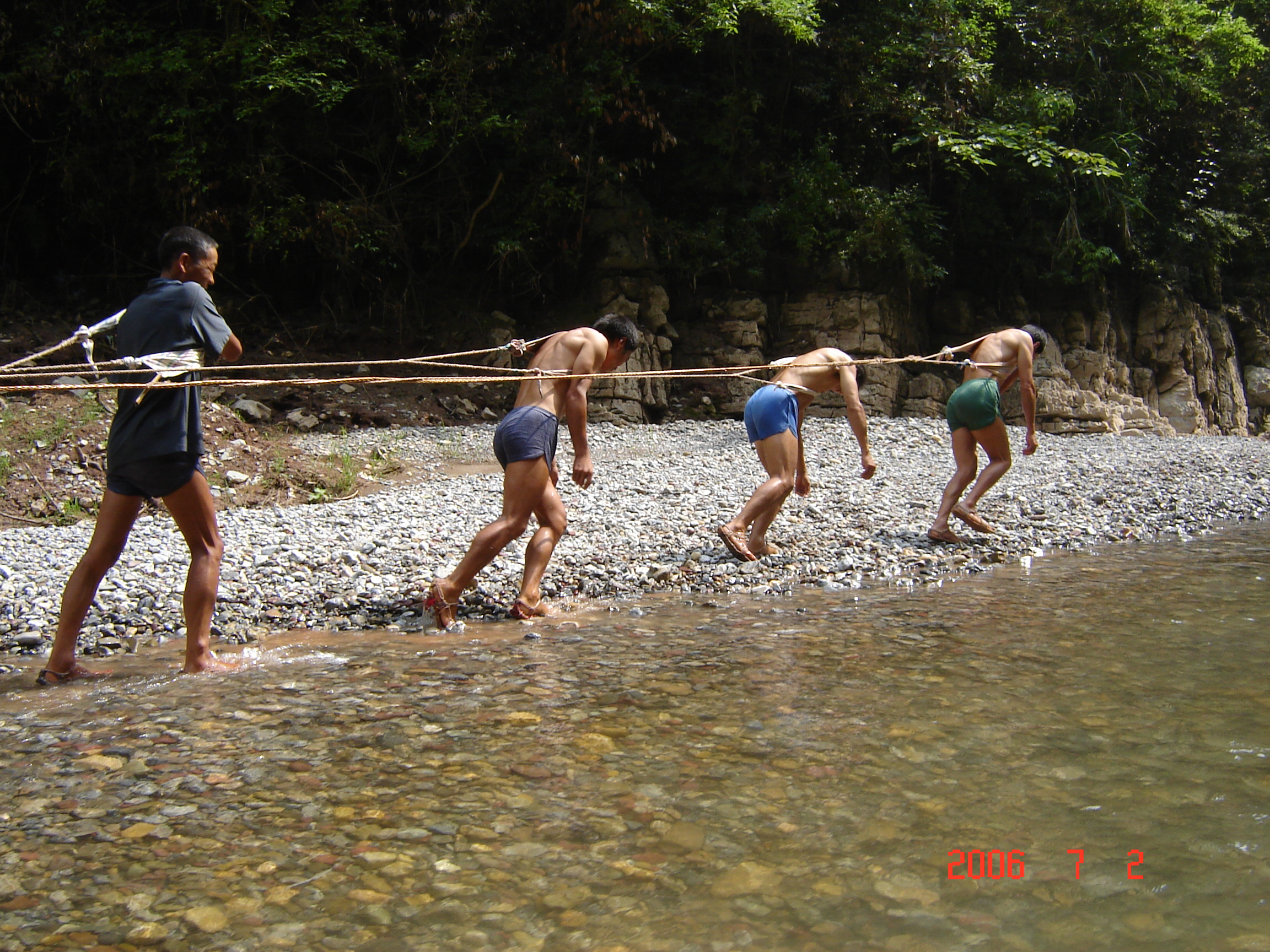
"I said that very little had changed on the yangtze. People still fished in the old way; the sailed, rowed and towed wooden junks; they watered their fields carrying buckets on yokes."

In one scene he describes men called trackers who pulled sailing junks up against the current by scrambling over rocks in their bare feet.

http://www.mitchellteachers.org/ChinaTour/Pictures/ShennongGorge&Trackers/ShennongTrackers4.jpg

http://www.allposters.com/-sp/2-Rows-of-Chinese-Trackers-Plodding-Along-Bank-of-Yangtze-River-Towing-a-Junk-Slowly-Up-River-Posters_i3591975_.htm

http://archive.bangordailynews.com/2001/12/01/river-trackers-tales-of-men-who-make-a-living-from-chinas-yangtze-river/

In ancient times these trackers were whipped.
Now, I read that they pretty much just pull boats for tourists.

After the first piece of writing, there were two more with a focus on China, but the second got too political for me and I abandoned it.

What an awful way to work!
******************************************
Shorter bits of reading had me pulling out an old National Geographic from the bathroom bookcase and reading in more detail of just how terrible we were to the Lakota Indians, how disengenuous, how brutal, how easily we killed them with a survivor reporting a mother killed and her baby still suckling, not knowing she was dead. There too was the pride in their refinding old ways and coming back enough to feel Lakota again. Still, this was a terrible story.

And in the Insomniacs Dictionary I read list of words with the -cide suffixof like senicide, a permanent solution to old, sick and grumpy. I guess I should be less grumpy.
And -phobia words. If found out that montony in one sense of its meaning is a synonym for homophobia, and that seemed both odd etymology but like senicide seemed to hold a sliver of common sense.
Here too were -mania words and clinomania seemed to perfectly define part of my condition.

Monday, February 25, 2013

Dinosauer reading

The Upper Room

http://aalbc.com/reviews/the_upper_room.htm

This novel was in my Black literature section at home and since it was set for the most part in Florida, I thought it a good one to bring down for the winter.  I am enjoying it.  I have read really nothing much like it before.  lt is a strange vision of really poor and poorly educated Black community and is almost dark and funny.  The central character catches out attention; however, at times there is just too much repetition of the same rants.  The novel could have been shorter and done just as much.  Still, I keep reading and am about half way through.

The central character talks a good bit of Jesus but is basically amoral and narcisistic to a radical degree.  She kills anyone who gets in her way, even those who just basically annoy or in a vague way threaten her.  She believes she has magical powers and so do those in her family and community, but it is all simply strong assertion of a powerful will. No one can get in the way of Mama Ruby and live.

I can't say this is the best novel I've read.   It is too simplistic and the characters are all shallow with few real complications and no depth.  The main character simply rants about Jesus and the Devil, tries to use her healing hands, and murders men who get in her way and tries to isolate her "daughter" Maureen from the world.  The dead are all men in this book, those that are killed and those that just die. 
Still there is some fascination to the strange community of people and the rules that govern it.  And the reverse prejudices are interesting as well.
There are few good men and few good whites.  Big Red the sherriff is good to Mama Ruby in some ways but totally corrupted.

In the end it was just as disappointing.  Some of the resolutions seemed fitting.  Most of it seemed silly, really.  Still, for some odd reason I'm happy to have read the book.  Now i think it is time to get back to oysters. 
 

Thursday, February 7, 2013

Tender is the Night

Perhaps one of the best illustrations of just how poorly I read lately is to say that I have just ow finished the Fitzgerald, which went to France with me and was supposed to be finished for the book group I get emails for but do not attend in mid November.
Another sad commentary, and a good reason for this blog, is that I've read this novel before, in fact, I've read this particular book before, and there in the final pages are a few of my notes. 
I don't remember it.
And having read it again, I can't really say it was something I managed to get a lot out of.  Too much was too obscure.  Too much required that one have sympathy for the independent rich.  I don't. 
The idea of suffering so much on the Riviera has always seemed to me absurd.

Perhaps I'll see what they did with it in a movie or read some crtical analysis to see what it is that I've missed.

I could not quite get Dick's inner struggles.  They all seemed too melodramatic.
I did chuckle that the last bit of his life was spent in small towns of the finger lake area.  It is these places that are presented as certainly the dullest places to live and work.  So hard for me to get that as I think of them as certainly as delightful as the riviera, perhaps more so.

Well, I enjoyed the book, nonetheless.  It did hold my attention.  The young girl traveling with her mother hit home when we were on the Viking cruise because we met a young girl traveling with her mother.  And there we were in France and having some of the kind of social interactions with people that are experienced on the Riviera.  A Viking cruise is a bit like the Riviera for modern travelers indulging themselves with a bit of Europe.

Best is that I am done with the novel. I've finished one of the dozens of books that sit on shelves here and at home with book markers in them. 

I intended to just toss this volume away in France, but it came home with me, and I guess I'll just keep it.  The last page is not attached but folded in half and kept in the book almost as a bookmark. The cover is detached.  The back cover is gone.  The book is really functionally useless.  But now that it has these personal struggles of these characters in it, I guess I'll keep it.