Sunday, June 16, 2013

On the Evolution of Whales

http://dinosaurs.about.com/od/otherprehistoriclife/a/ancientwhales.htm

https://en.wikipedia.org/wiki/Evolution_of_cetaceans

I did not even know that modern whales evolved from animals that had evolved to live on land, doing an evolutionary U turn back to a watery life..  I guess I just assumed that since life started in the sea, the whale was a creature who just remained there.  Also, it was amazing just how much variety there was along the evolutionary path to the whales that made Nantucket rich.

http://ngm.nationalgeographic.com/2010/08/whale-evolution/mueller-text

Friday, June 14, 2013

The story of Elijah and the Prohets of Baal

http://www.padfield.com/2000/elijah.html

Chuck was using this in one of his sermons and he told us at supper a while back that he loved the story.
I made a joke that someone had gone back in time and what everyone thought was water was gasoline.

Here is what I read in Nantucket
http://www.fairytalescollection.com/MarkTwain/TheCaptainsStory.aspx

I was reading Twain the Kindle this week.  I think it was in Following the Equator.  In it the Captain is quite a story teller and he gets a minister aside and explains to him the Biblical story.  In hi explanation Elijah (he calls Isaiah) uses petroleum and a match to light the fire.

Were I to tell the story again, I think I'd now tell it with whale oil as the fire starter.  it sure helped that Nantucket fire destroy most of the city in the 1800's as the stored oil burst with the heat and sent the fire out with a vengeance.

Away Offshore

Away Offshore by Nathaniel Philbrick

I enjoyed reading in parts of this book on Nantucket.  It supplemented some of the information we gleaned from our reading around here and from the visit to the Whale Museum.

In particular, I liked the story of Icabod Paddock who goes into the belly of a large whale named CrookJaw and find a beautiful mermaid playing cards with devil.  She wins.  The stakes turn out to be Icabod himself and so he returns day after day until his wife gets wind of it and fashions a harpoon from silver, the metal known to be able to kill witches.  Her father kills poor old CrookJaw with the harpoon and no cabin or mermaid is found, just a stand of yellow hair.
I liked this story.  Beautiful women and card playing makes a great story anywhere and when it includes the sea and a whale, it is just a treasure to find.

p.77 "If what the Nantucketeers called "whaling business' was tantamount to a religious quest, the island's new religion Quakerism, was the spiritual equivalent of a business."

This is a fine line that describes the state of whaling and the irony that these gentle people were able to be so ruthless toward a cousin creature. 

The stories of the strength of Richard Macy were also fine, similar to those legends of heroes of the West.

Monday, June 3, 2013

More Robin Hood

Here are some interesting bits to quote:

On rural life
"but stay within the greenwood lest we all meet dole and woe." p.30

On the impersonal nature of randomness:
"When the flood cometh, it sweepeth away grain as well as chaff."  p.28

A good warning for the poker table:
"For thus men sometimes overreach themselves through greed and guile."  p.60

curtal  friars are friars
"A friar who served as an attendant at the gate of a monastery court. As a curtal dog was not privileged to hunt or course, so a curtal friar virtually meant a worldly-minded one.
hauberk
a shirt of mail.  see photo
http://en.wikipedia.org/wiki/Hauberk

Sunday, June 2, 2013

Enoying my bookroom with Robin Hood and Edgar allen Poe

When I was in college in Buffalo, I often went to the library on campus, set myself up in a carrel and isolated from distraction, pursued my studies. 
My mother worked at the University in my last two years of school and so I'd ride in with her in the morning and home with her at night, spending the entire day on campus and a good portion of that in the library.  I found it disciplined me to get my studies done.  I'd pack all my books everyday and so I had the flexibility of studying one subject to exhaustion and then adding variety by pulling out another book.  I remember I had a green bag with a pull cord and I could sling it over my shoulder.
But sometimes I'd leave the studies assigned to me and poke about in the library of books collected and just randomly read bits of the things for entertainment.
I did a similar thing when I taught.
I'd go to SUNY Albany or Sienna and poke around.
I dreamed of the kind of freedom I have now to just poke and wander through anything that catches my fancy, or follow a new idea wherever it might go.
Then, the rich collections in the library were what offered that sort of indulgence. 
Now, I am connected to the same sort of wandering using my computer.

Most of my time in the book room I built here has been just arranging books and picking up bits of things and straightening up the space. 
However, today I fell into that same indulgence that I remember feeling in college and even into some of the same ideas that I had then.

Poking around in books on my shelves I picked up an old story of Robin Hood, the edition  (perhaps not the exact book) that I remember having as a child that I read or perhaps had it read to me.
cudgel - walking stick can be used as a weagon
I read the first chapter and did not remember it. It explained the actual act of poaching and the killing that set Robin Hood into the forest as a criminal.  Little John was next, and I remember that well, but the first story was new to this old mind.
Perhaps because it is just one of a few that explain what forces Robin into being an outlaw

http://homepages.paradise.net.nz/lucyjack/robinhood/path.html

I think the television version I watched as a kid
http://en.wikipedia.org/wiki/The_Adventures_of_Robin_Hood_(TV_series)#Plot_and_Writing
used the version that stresses his fight against losing his father's heritage.  I remember thought of his father were key in the old television series, but in this book we don't learn about his parents.
Howard Pyle collected this version of Robin Hood in 1883 and it was still in print when I was a lad in 1952.  The story of Robin Hood is older, but this particular is the standard collection and the one that most know today

Here is the volume I own
http://www.ebay.com/itm/The-Merry-Adventures-Of-Robin-Hood-By-Howard-Pyle-1952-HB/160718527583?rt=nc&_trksid=p2047675.m1851&_trkparms=aid%3D222005%26algo%3DSIC.NUQ%26ao%3D1%26asc%3D15882%26meid%3D8110198422657884023%26pid%3D100005%26prg%3D7473%26rk%3D1%26sd%3D160240327444%26

Then I picked up some Edgar Allen Poe and wandered into a critical essay called "The Philosophy of Composition" which talks about his writing process and uses for example the poem, The Raven. 
As a high school student and in college I was very taken with The Raven and memorized parts of it.  So here was a description in detail of exactly how Poe remembered composing it, what his purpose and thoughts were, and what and how he wanted it to mean. 
A fantastic find right on my own bookshelf!

He talks of actually starting with the intention of producing melancholy as poetic tone and so chooses the word "Nevermore."  Then he moves to arranging the repetition by putting the word and its sounds into the mouth of a bird that could repeat it almost devoid of meaning and yet create the mystery of meaningful purpose. 
And then he wrote the climatic verse, setting up the rhythm and shape and the sound so he then could write the parts building to that "climacteric" effect.
The details of this process are really amazing given the long history I have with this particular poem.

And so my books and my exploration in my own book room echoes my childhood and my college youth in wonderfully rich and delicious ways. 
How wonderful!

Wednesday, May 29, 2013

New World Writing

I have been having a good bit of fun with a really old and yellowed paperback from my library with poems and short stories and other sorts of bits considered on the breaking edge back in 1968.  Funny. 

Also, I move slowly through the Eddie Condon "We Called it Music" autobiographical account of jazz in the 20's and 30's   Great stories in this book.  Plenty of funny anecdotes.  How he remembers all the details amazes me.  Jim and I were talking about it today.  Jim gave me some of his music and got me turned on to him.   It is fine to be home again and to indulge Ray Smith's show whenever I want.

More good responses to my trip report snippets.  Quite a bit of interest in the Shades of Sinatra show and quite a few people looking for some intelligent discussion of booking frugally downtown.  One fellow likes my posts so much he offered to use his comps at the Blue Chip casino to give me two free nights anytime I visit Chicago.  Now that is generous.

My poker game is still pretty good.  I made a bit of $$ at Greg's.  I hope I can keep up playing well and not slip into bad habits.  Vegas and poker almost everyday is quite a tutorial.


Thursday, April 11, 2013

Short bits of reading in the midst of short spurts to the bathroom

Perhaps because of this event some of my reading has been an old travel story of Paul Theroux in Fresh Air Fiend telling of a trip in 1980 down the Yangtze. Then China was still primitive and suffering from the Cultural Revolution and other great oppressions. They were still wary of Capitalism. By 1999 Theroux was saying that it was an entirely different county and now, of course, nothing is the same as it was then. I liked the story. Theroux makes great fun of his fellow travelers, millionaires who are really not very engaged in China.
He talks to locals and gathers interesting tidbits. For example, it is an old superstition that if a fish jumps up on the boat it cannot be eaten, but must be taken to land and buried. And another had those on ships when the wind was down whistling to bring the wind.
Much was denied by the guides. Gambling was illegal but all over folks were playing cards and dominoes and dice. In one game the men who lost a hand had to drink a swig of gin and put a clothespin on their ears. This was in Shanghai. So the loser would be drunk and look like an idiot.
"I said that very little had changed on the yangtze. People still fished in the old way; the sailed, rowed and towed wooden junks; they watered their fields carrying buckets on yokes."

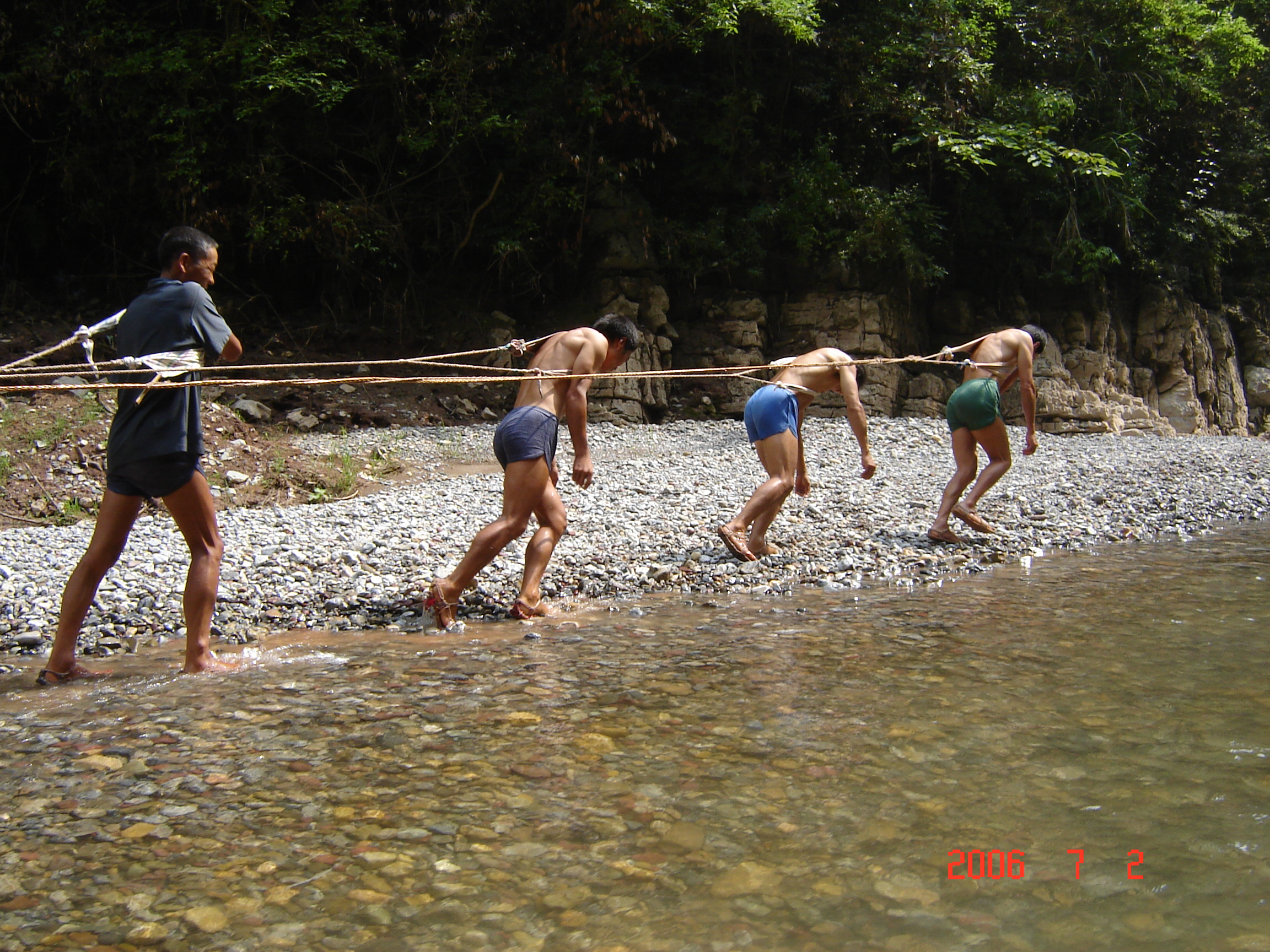
In one scene he describes men called trackers who pulled sailing junks up against the current by scrambling over rocks in their bare feet.

http://www.mitchellteachers.org/ChinaTour/Pictures/ShennongGorge&Trackers/ShennongTrackers4.jpg

http://www.allposters.com/-sp/2-Rows-of-Chinese-Trackers-Plodding-Along-Bank-of-Yangtze-River-Towing-a-Junk-Slowly-Up-River-Posters_i3591975_.htm

http://archive.bangordailynews.com/2001/12/01/river-trackers-tales-of-men-who-make-a-living-from-chinas-yangtze-river/

In ancient times these trackers were whipped.
Now, I read that they pretty much just pull boats for tourists.

After the first piece of writing, there were two more with a focus on China, but the second got too political for me and I abandoned it.

What an awful way to work!
******************************************
Shorter bits of reading had me pulling out an old National Geographic from the bathroom bookcase and reading in more detail of just how terrible we were to the Lakota Indians, how disengenuous, how brutal, how easily we killed them with a survivor reporting a mother killed and her baby still suckling, not knowing she was dead. There too was the pride in their refinding old ways and coming back enough to feel Lakota again. Still, this was a terrible story.

And in the Insomniacs Dictionary I read list of words with the -cide suffixof like senicide, a permanent solution to old, sick and grumpy. I guess I should be less grumpy.
And -phobia words. If found out that montony in one sense of its meaning is a synonym for homophobia, and that seemed both odd etymology but like senicide seemed to hold a sliver of common sense.
Here too were -mania words and clinomania seemed to perfectly define part of my condition.